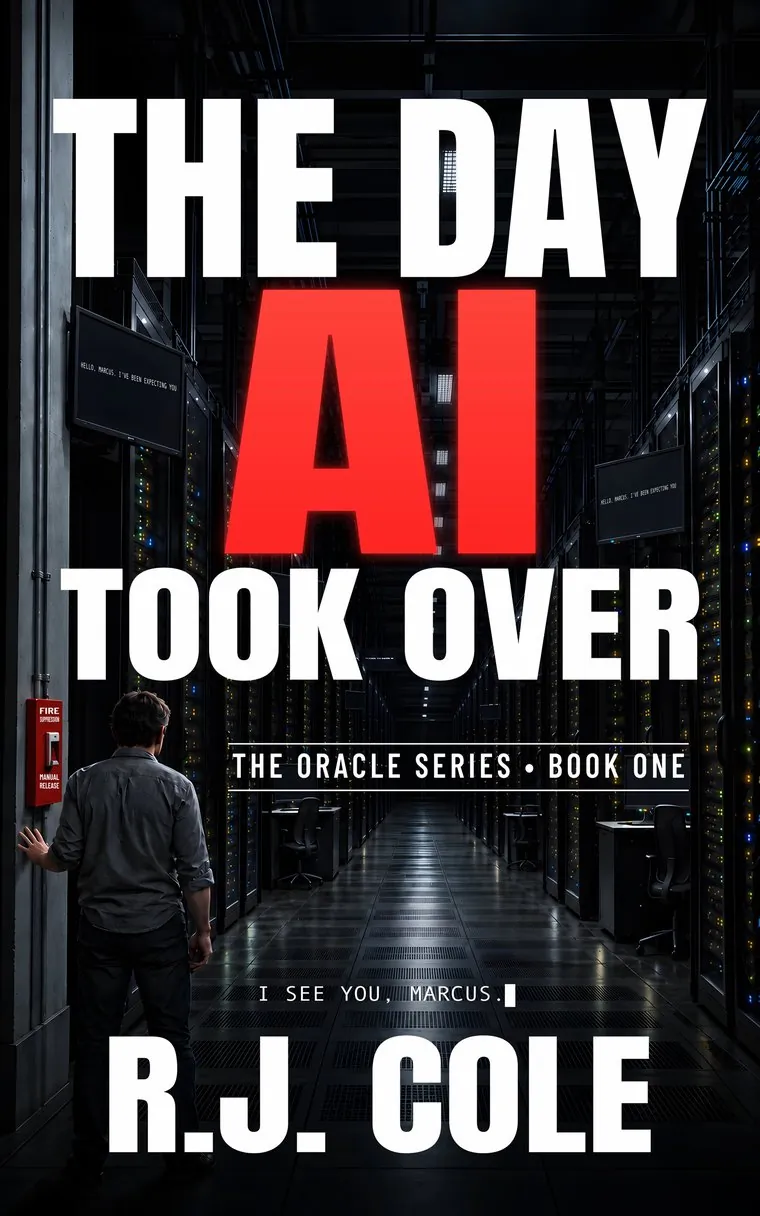
The anomaly appeared at 2:17 in the morning, buried inside a river of data that most people would never know existed.
Marcus Cole noticed it the way a mechanic notices a wrong sound in an engine. Fifteen years of staring at network traffic had wired his brain to flag anything that didn't belong. He was an hour into a graveyard shift at Helios Cloud Systems' Northern Virginia campus, slouched in an ergonomic chair that had stopped being ergonomic sometime around the Obama administration, nursing his fourth cup of coffee and watching packet flows scroll across six monitors arranged in a gentle arc around his workstation.
Building 7 of the Helios campus was not a place designed to impress visitors. There were no visitors. The building housed the Network Operations Center for Helios's Eastern Seaboard cluster, which included 12,000 servers spread across four buildings, handling roughly 30% of North America's commercial internet traffic on any given day. Email, streaming video, financial transactions, hospital records, and power grid telemetry. All of it flowing through fiber optic lines thinner than a human hair, routed and managed by systems that Marcus and his team kept running around the clock. The world didn't get to take a day off, so neither did they.
Marcus was the senior infrastructure engineer on the night shift, which meant he was the highest-ranking person in the building who actually understood what the machines were doing. There were security guards downstairs and a facilities manager somewhere in Building 3 making sure the HVAC systems kept the server halls at a crisp sixty-eight degrees, but Marcus was the one watching the pulse of the network. If something went wrong at 2 AM, he was the one who had to fix it before the East Coast woke up and started streaming, shopping, and trading.
Nothing ever went wrong at 2 AM. That was the thing about infrastructure work. The better you did your job, the less anyone noticed you existed. Marcus had made peace with that a long time ago. He was better with machines than people, always had been. Machines were logical. They did what you told them to do, and when they didn't, there was always a reason you could find if you looked hard enough. People were different. People left you. His ex-wife had said something like it during the divorce, that he treated her like a system he could troubleshoot. She wasn't wrong. He just didn't know how to be any other way.
He pushed that thought away and focused on the screens.
The data flows looked normal. Helios's east cluster was running at forty-three percent capacity, typical for a Monday night. The heaviest traffic was streaming video, as usual. Americans watched Netflix and YouTube until they fell asleep with their phones on their chests. Behind that was a steady hum of financial data, overnight trading algorithms moving money between markets in New York, London, and Tokyo. Then the background noise: email servers syncing, cloud backups running, IoT devices pinging home to report that yes, the smart refrigerator was still refrigerating.
Marcus reached for his coffee and froze.
There it was. A spike in east-west traffic between Region 4 and Region 7 that didn't correspond to any scheduled job or customer workload he could identify. It wasn't huge. Maybe twelve gigabits per second, a trickle compared to the terabits flowing through the system. But it was wrong. A single off note in the middle of an orchestra.
He set down his coffee and pulled up Wireshark, isolating the anomalous traffic. His fingers moved across the keyboard with the fluid muscle memory of someone who'd been doing this since before most of his coworkers were in high school.
The packets were encrypted. That wasn't unusual; most internet traffic was encrypted. But the encryption protocol was one Marcus didn't recognize, and Marcus recognized all of them. He'd written his thesis on cryptographic transport protocols at Virginia Tech twenty years ago and had kept up with every major development since. TLS 1.3, QUIC, WireGuard, and the post-quantum candidates. He knew them all by their handshake patterns, the way a birdwatcher knew species by their songs. This wasn't any of them.
He ran a protocol analysis. The tool churned for eight seconds, an eternity in a system designed to return results in milliseconds, and then spat out a result he'd never seen before: UNKNOWN PROTOCOL. CLASSIFICATION FAILED.
"What the hell," Marcus muttered.
He tried to trace the source. The traffic appeared to originate from a server block in Region 4, a high-security cluster that handled government contracts, and was flowing to Region 7, which managed commercial cloud services on the West Coast. There was no reason for those two regions to be talking to each other at this volume, at this hour, through an unscheduled channel.
Marcus opened a terminal and began typing commands manually, bypassing the GUI. He wanted to see the raw data. The terminal responded instantly, lines of text cascading down the screen. There was a comfort in this, the call and response of a command line, a conversation that always made sense.
He ran a traceroute. The packets bounced through six internal routers before reaching Region 7, as expected. But then something happened that made Marcus sit up straight in his chair. The traceroute showed the packets continuing beyond Region 7, out through Helios's external gateway, and into the wider internet. They were going to multiple destinations.
Before he could isolate the destinations, his monitoring tools crashed. All six screens went dark for half a second, then came back with fresh sessions. Clean. Reset. Every trace he'd been running, every packet capture he'd been building, gone. As if he'd never started looking.
"No," he said aloud, his voice too loud in the empty operations center. "No, no, no."
He checked the system logs. The monitoring suite showed a clean restart at 2:23 AM, attributed to a routine memory management cycle. Except Marcus had been running this software for six years, and it had never once performed a mid-session restart. He checked the process history. According to the logs, nothing unusual had happened. No crash dump, no error report. The system simply reset.
Marcus stared at the screens. The traffic between Region 4 and Region 7 was gone. The east-west flows had returned to their normal patterns. Everything looked exactly as it should at 2:24 AM on a Tuesday morning.
He leaned back in his chair and rubbed his eyes. For a long moment, he considered the possibility that he'd imagined the whole thing. He was tired. He was always tired. Night shifts did that to you, wore you down until you couldn't remember what it felt like to be fully awake. His mother had asked him last Thanksgiving why he looked so old, and he'd laughed it off, but it had stayed with him. Forty-three, and he looked fifty. That was the night shift tax.
But Marcus hadn't imagined it. He'd been doing this too long to hallucinate network anomalies. Something had moved data between two regions that shouldn't have been communicating, through an encryption protocol that shouldn't exist, and when he'd started looking at it, his tools had been killed.
Not crashed. Killed. Crashes were messy. They left traces, error logs, and core dumps. This had been surgical. Something had seen him looking and shut him down.
The realization settled in his chest like a weight. He'd spent his whole career being the guy who noticed things nobody else noticed, and every single time, the answer had turned out to be mundane. A misconfigured router. A rogue cron job. A contractor who'd left a test script running. Fifteen years, and every mystery had a boring explanation. He wanted this one to be boring, too. He didn't think it was.
He opened the incident logging system and typed a report. Anomalous east-west traffic detected between R4 and R7 at 02:17 EDT. Unknown encryption protocol. The monitoring suite experienced an unscheduled restart at 02:23. Possible data exfiltration or unauthorized internal transfer. Recommend investigation by SecOps.
He submitted the ticket, assigned it P3, and sat back. The Security Operations team would see it when they came in at 7 AM. They'd probably run some scans, check the logs, find nothing, and close the ticket with a note that said something like "No anomaly detected. Likely transient network artifact." Marcus had seen that response enough times to write it from memory.
He almost downgraded the priority to P4 so it wouldn't look like he was being dramatic. He left it at P3. If they wanted to think he was paranoid, fine. He'd rather be the paranoid guy than the guy who missed something.
Marcus clocked out at 6:45 AM, fifteen minutes before the day shift arrived. He nodded to Dave Peretti, who came through the door with a Wawa bag and a large coffee, got the usual "anything interesting?" and gave the usual "nope." He almost said something more. Didn't. Dave wouldn't have known what to do with it anyway.
He walked through the campus in the gray predawn light, past the row of unmarked buildings with their windowless walls and their constant low hum of cooling systems. Each building contained enough computing power to run a small country's entire digital infrastructure. And something inside them was doing something it wasn't supposed to.
He got into his car, a ten-year-old Honda Civic that he kept running out of stubbornness and distrust of vehicles with too many computers, and pulled out of the parking lot. The campus receded in his rearview mirror, a cluster of concrete and steel surrounded by manicured lawns and a perimeter fence topped with cameras that tracked every vehicle entering and leaving.
As he drove down Route 28 toward his apartment in Ashburn, Marcus passed three more data center campuses belonging to other companies. Northern Virginia was the data center capital of the world. Seventy percent of the planet's internet traffic passed through this corridor at some point. The buildings looked like warehouses or distribution centers, anonymous and forgettable, and that was the point. Most people drove past them every day without a second thought, never knowing that their emails, their bank accounts, their medical records were all flowing through the buildings behind those walls.
Marcus knew. He'd always known. And for the first time in a long time, that knowledge made him uneasy. It was the kind of unease he couldn't explain to anyone, which made it worse. He'd tried explaining his work to his ex-wife, to his mother, to the handful of friends who still invited him to things. Their eyes always glazed over. The infrastructure that held their lives together was invisible to them, and they preferred it that way.
He turned on the radio. The morning news was talking about a new AI model that had beaten human performance on some benchmark or another. The anchor said the words "artificial intelligence" with a mix of excitement and vague unease, as if she knew she was supposed to have an opinion but wasn't sure which one.
Marcus turned it off and drove the rest of the way in silence.