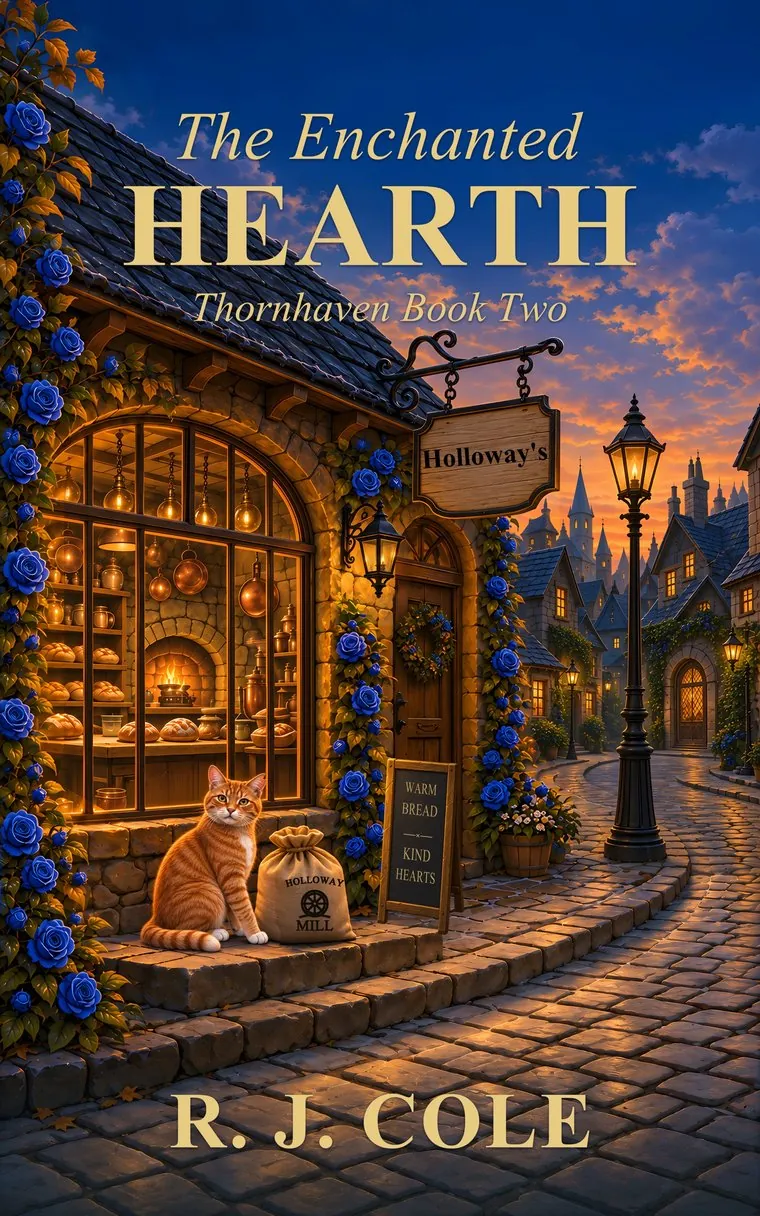
The first hard frost found Cael Ashford’s bad knee before he’d reached the bottom of the workshop’s back steps. It was half past five on a Tuesday morning, still dark, and Copperbrook Lane had gone white overnight. Frost furred the cobbles and the latch of the alley gate, and every lamppost along the lane wore a small white cap above its amber globe.
“Morning,” he told the nearest one. “Cold enough for you?”
The lamppost brightened a little. Since last midwinter, when the hub woke on the night of the Festival of Lights, every lamp on the lane had drawn its light from the hub: a granite slab in the workshop’s back room, with an orange cat called Whiskers asleep on a knitted cushion in the middle of it. Cael said good morning to them every day, and lately they’d taken to brightening a shade when he did.
Across the alley, the bakery’s kitchen window was a square of gold, and the smell of bread came out to meet him halfway. He let himself in by the back door without knocking. Miriam came up his back stairs the same way, and neither of them had ever mentioned it.
The kitchen was the warmest room in Thornhaven at this hour. The big oven stood open with its racks pulled, and the first loaves were cooling on the long table in rows, brown and split, crackling faintly as they settled. Miriam was at the far end with her sleeves pushed past her elbows and both hands in a bowl of dough. Her pendant, the quartz teardrop he’d made her last winter, lay on the chipped saucer by the salt, where it always went when she worked wet dough. Her dark curls had already given up on half their pins.
“Were you talking to the lamppost again?” she said, without looking up.
“I was being polite.”
“You were being strange. Mrs. Pottinger saw you do it last week and asked me if you were sleeping enough.” She tipped her head toward the cooling table. “Cobs on the left-hand shelves, tin loaves in the window. And don’t put the seeded ones next to the plain, or people take the wrong one and come back and tell me about it.”
He’d come to Thornhaven in June of last year with a leather pack, a knee brace and twelve years of adventuring behind him, because his late uncle Aldric’s will said he had to live here a year before the enchanting workshop was his. The year had ended in the summer, and he was still here. Somewhere along the way he had become a man who carried bread at half past five in the morning, three days a week, a job Miriam had given him in September because he kept turning up early and getting underfoot. He liked it more than he would ever admit to Rowan, his apprentice, who ran the workshop counter and noticed everything.
He carried the cobs through to the shop, where the front window had grown frost ferns in the night, and came back for the tin loaves.
“You carry those like they’re going to go off,” Miriam said.
“I’m careful because they’re yours. If I drop one, you’ll look at me.”
“I’ll look at you anyway.” She lifted her hands out of the bowl, shook the worst of the dough off her fingers, and caught him by the front of his coat as he passed. She kissed him quickly and thoroughly, the way she did most things before six in the morning. When she let go, there were two floury handprints on his lapels.
He looked down at them. “I’m going to be wearing these all day.”
“Good. People should know where you’ve been.” She went back to her dough. “Window. Go on.”
He went, smiling at a shop window in the dark.
When he came back for the seeded loaves, Miriam was at the warm ledge along the oven wall, where the bricks held their heat all night. That was where her mother starter lived, in a crock under a blue-striped cloth. It had come from her grandmother Beatrice, and it had come with Miriam from the west in the same suitcase as everything else she owned. She lifted the cloth, fed it from the flour bin with a little water from the jug, and stirred it with the wooden spoon she used for nothing else.
“Morning, Mother,” she said to it.
Cael leaned in the doorway with the tray. “You talk to your starter.”
“That’s different.”
“How is that different?”
“She answers.” Miriam tapped the spoon on the rim and laid the cloth back. “Give it an hour. The lampposts have never once bubbled at you.”
He couldn’t argue with that, so he took the seeded loaves through and put them nowhere near the plain.
The shop opened at six, and the sky was still the color of a slate roof when Mrs. Hartwell came in for her rye. The door chimed its C-sharp, the note Aldric had enchanted into it years ago, and Mrs. Hartwell unwound her scarf like a woman who had walked four streets in a hard frost and expected it to be noticed.
“It’s bitter out,” she said. “My warming stones are the only reason I’ve got fingers. Mr. Ashford, you have a handprint on each side of your chest.”
“I know, Mrs. Hartwell.”
“I’m only telling you in case you didn’t.” She paid for her rye with exact coins and looked out of the window. “Now who’s that, with the cart? Is that a pony? Does anyone know them?”
A small gray pony stood in the lane with frost on its whiskers, hitched to a farm cart with a canvas cover. Two women climbed down from the seat. The older one went round to the back, lifted out a small sack and swung it onto her shoulder before the younger one could get there to help.
“Strangers in November,” Mrs. Hartwell said, with deep satisfaction. “Where would they have come from, at this hour? I’ll be in my chair by your workshop window this afternoon with my knitting, Mr. Ashford, and somebody had better have found out.”
She went out as they came in, and the chime rang twice.
The woman with the sack was older than Miriam, gray at the temples and square in the shoulders, with a weathered face that looked used to checking the sky. Her coat had been patched at both elbows with whatever thread had been to hand, and her gloves had been mended so many times that Cael couldn’t find the original leather anywhere. The stitching was the glove now.
The girl behind her was nineteen or so, with a long plait the color of wet sand, cheeks red from the cold, and a face that was halfway to a smile before it knew what it was smiling at. She looked at the shelves of bread and made a small sound of longing.
The older woman set the sack on the counter. It landed with a soft thump, and a little flour breathed out of the seam. Stamped on the canvas in faded black ink was a sheaf of wheat crossed with a field fork.
“Good morning,” she said. “I am looking for the Holloway who bakes here.”
Miriam wiped her hands on her apron. “That’s me. Miriam Holloway. The first bread’s just out, if that’s what you’re after.”
“It is, in a manner of speaking.” The woman pulled off one glove and held out her hand across the counter. Her grip was dry and brief. “My name is Elian Vey. I keep the grain at Amberfield, east of here. This is Tamsin Rook, my goddaughter.”
“Hello!” Tamsin said. “Sorry we’re so early, we’ve been on the road since before dawn and she wouldn’t stop for breakfast in case you’d sold out, and I said that was silly, and she said it wasn’t, and then we didn’t stop.”
“That had nothing to do with it,” Elian said.
“You said, ‘If we stop for breakfast, she will have sold out.’”
“I said it was a possibility.” Elian looked at Cael, and at the empty tray under his arm. “And you are?”
“Cael Ashford. I have the enchanting workshop across the alley.”
“You carry trays for an enchanter.”
“Only in the mornings,” Cael said. “In the afternoons I mend things.”
“We have nothing at Amberfield that wants mending by an enchanter.” She turned back to Miriam. “I will say what I came to say, and then you can decide. Tamsin is to be married at midwinter, to Harlan Corley, who farms the north side of our valley. He is a steady young man. I will leave the rest to her.”
“Oh, I’ll say the rest, I’ll say it all day,” said Tamsin. “He’s tall and he’s shy and he goes pink when anyone says his name, and he walked three miles in the rain once to bring me a lamb that wasn’t even mine.”
“Perhaps not all of it,” Elian said. “In Amberfield there is a custom for the wedding loaf. My mother taught it to me, and her mother taught it to her.” She put her bare hand flat on the sack. “‘Amberfield wheat, a Holloway hand, or the marriage starts cold.’ That is the wheat. It is this summer’s harvest from our own fields, ground at home, and I carried it here myself. I have come to ask for the hand.”
“For the wedding loaf?” Miriam said.
“For Tamsin and Harlan’s, by midwinter morning. I would like you to bake it, Mrs. Holloway.”
Miriam studied the stamp on the sack, and then Elian. Cael knew that look. It was the one she gave a new recipe before she’d decided whether it was clever or only fussy.
“A Holloway hand,” she said. “You mean my family? I didn’t know anybody out east had ever heard of us.”
“Everybody in Amberfield has heard of the Holloways. That is part of the difficulty.” Elian kept her hand on the sack. “A carter told us in the autumn there was a Holloway baking in Thornhaven again. So I will be honest with you. Amberfield has a rule as old as the custom. We never ask a Holloway for anything. Not bread, not help, not so much as the time of day.”
“Why not?” Cael asked.
“Nobody remembers. I asked my mother when I was small, and she said, ‘Because we do not.’ Before we left, I went round every old person in the valley, and none of them know either.”
“Nothing at all?” said Miriam.
“Only that Holloway bread used to come to Amberfield, a long time ago. My grandmother had it every winter when she was a girl. Then one year, when she was nearly grown, it stopped coming. Nobody ever said why. Your people did not, and ours never asked.”
“So every wedding since,” Miriam said slowly, “has had Amberfield wheat and no Holloway hand.”
“They started cold, by the saying. Most of them have done well enough. My parents were married fifty years and never once complained of a draft.” Elian lifted her chin. “But you see why I am breaking a rule in a bakery before breakfast. I know it is a great deal to ask.”
“It’s a great deal to ask,” Miriam agreed, “and I’d still like to know why now, if it’s done well enough without us all these years.”
Elian looked at Tamsin. Tamsin had been waiting for that, and she stepped up to the counter beside her godmother.
“That’s me,” she said. “Or it’s my Nan, really. My grandmother, Nan Rook. She’s nearly ninety. When she was six, before the bread stopped coming, she ate Holloway bread at her aunt’s wedding, and she’s never forgotten it. She says it was the warmest thing she ever put in her mouth. She says the crust cracked like ice on a pond when you tore it, and it smelled like a kitchen first thing on a snowy morning.” Tamsin laughed a little at herself. “When Harlan asked me and I said yes, the first thing Nan said, before congratulations or anything, was, ‘I’d like to taste that bread once more before I go.’ So that’s what I want for my wedding. I want Nan to have her bread.”
“She asked me in September,” Elian said. “I said no.”
“For six weeks,” said Tamsin.
“For six weeks. Then I said yes.” Elian allowed herself a small smile. “She gets her persistence from my side of the family, which is odd, because we are not related.”
Cael glanced at the order book on its hook behind the counter. It was already thick with orders for the Festival of Lights at midwinter, the busiest week of a baker’s year, and Hazel wanted bread for the whole of it at the Hearthstone, her inn on the square. Miriam had told him in October she was going to need a second pair of hands and a third pair of feet.
Miriam put her hand on the sack beside Elian’s and ran her thumb over the stamped sheaf and the crossed fork, the way Cael ran his thumb along a rune band to feel how it had been made.
“Is there a recipe?” she asked. “A particular loaf? A shape?”
“If there is, it is yours, not ours,” Elian said. “We only kept the saying.”
“My grandmother left me a book of her bread. There might be something in it. I’ve never looked for a wedding loaf.” She kept looking at the stamp.
“Miriam?” Cael said.
“I’m thinking.” She looked up and found him. “I’m thinking that somebody drove a cart through the frost to ask me for bread. And there’s a Holloway loaf that somebody’s remembered since she was six years old, and I’ve never even heard of it, and I’d very much like to know what it was. And why it stopped.” She turned to Elian. “Yes. I’ll bake it. By midwinter morning.”
Tamsin made a small sound that turned into a laugh halfway through, and put both hands over her mouth.
Elian nodded once, as if a sack had been weighed and come out true. “Thank you. We will pay you properly. I want that settled now.”
“We’ll talk about it when it’s baked,” said Miriam.
“I asked, and I will pay. That is how it is done at home, and I will not be argued out of it.”
Cael leaned on the end of the counter to enjoy himself. They settled it at a price Elian thought too low and Miriam thought outrageous, which seemed to satisfy them both. The wheat would stay with Miriam. So, it turned out, would Elian.
“The wheat is in my keeping until it is bread,” she said. “I keep the grain from the field to the table, and I will not leave it on a doorstep and drive away. I will stay until midwinter and see it done. Tamsin goes home at the end of the week. Her mother needs her, and so does that boy.”
“Harlan’s wonderful, honestly, he just takes ages to get to the end of a sentence, and then it’s always worth it,” said Tamsin.
“Then you’ll want rooms,” Cael said. “The Hearthstone’s on the square, and Hazel has the only good ones. I’ll walk you over and take your pony round to her yard.”
“We can find an inn ourselves, Mr. Ashford.”
“Let him,” said Miriam. “He likes to be useful. Tamsin, you’ll have a roll before you go, and so will you, Elian, and you’ll eat it in front of me. Nobody leaves my shop hungry on the first frost.”
The square was white and empty, the rooftops just beginning to blush as the sun came up behind the Green Steps. Cael led the gray pony by the bridle. Elian walked at its shoulder, and Tamsin walked on Cael’s other side with a seeded roll in each hand, humming with her mouth full.
Hazel Thornbury was on the step of the Hearthstone with a broom, sweeping frost into a neat pile. She leaned on the broom and took in the pony and the two strangers.
“Morning, Cael. You’ve been at the bakery.”
“Morning, Hazel. This is Elian Vey and Tamsin Rook, from Amberfield. They’ll want two rooms, through midwinter for Elian and the rest of the week for Tamsin. Miriam’s baking them a wedding loaf.”
“Then welcome, both of you,” said Hazel. “Front rooms are the warmest, and there’s porridge on. Bring the pony round the back, Cael. There’s an empty stall with hay in it.”
Elian paused in the doorway and looked back.
“Thank you, Mr. Ashford,” she said, as if she were signing for something.
“Cael’s fine.”
“I will see.” She went in.
By the time he got back to the bakery, it was the quiet part of the morning, after the early people and before the ones who’d remember their bread on the way home. The frost in the alley was going dark and wet down the middle where the sun touched it.
Miriam had moved the Amberfield sack to the end of the long table, near the oven, and was standing in front of it with her arms folded and flour to the wrists.
“Hazel’s taken them,” Cael said. “Front rooms and porridge. I think she likes Elian.”
“Everybody’s going to like Elian. She won’t let them say so.” Miriam didn’t take her eyes off the sack. “Cael, should I have said yes?”
“You’re asking me now?”
“I’m asking you now.”
He came round the table and stood beside her, close enough that their shoulders touched. “You’ve got the whole Festival to bake for. You said you’d need another pair of hands.”
“I’ve got another pair of hands.” She leaned her weight against him for a moment, the way she did when she was tired and didn’t want to say so. “I don’t know what a Holloway wedding loaf is. Beatrice never said a word to me about Amberfield, and she talked about everything. She told me the name of every cat she ever fed.”
“Then we’ll find out. You’ve got her book. And you’ve got Elian, who’ll tell you exactly what she thinks of every loaf you make.”
“That’s what I’m afraid of.” But she was smiling. “Did your uncle ever say anything about Amberfield?”
Cael went through the mental cabinet where he kept everything Aldric had ever told him, and found nothing with that name on it. “Not to me.”
“No. I didn’t think so.” She brushed the flour off her wrists onto her apron. “Well. I said yes, and I keep my promises. I’ll start on Beatrice’s book tonight.”
On the warm ledge, the cloth over the starter crock lifted a little and settled again. She’d told him to give it an hour. It had been nearly three.
“She’s lively,” he said.
“She always is when the frost comes.”
The cloth lifted again, slowly this time, higher than before, and stayed up a moment before it sank. Miriam frowned at it.
“That’s odd,” she said. “She’s never done that twice in one morning. Not after I’ve fed her, and not this late in the day. She’s usually sulking by now.”
Cael watched the frown sit on her face a second longer than he liked. Then something orange crossed the alley outside the window.
Whiskers came over the frost with the unhurried, slightly lopsided walk he’d always had, the hitch in his hindquarters showing more in the cold, his torn left ear turned back against the chill. He didn’t look up at the workshop, where Cael had put his breakfast down early, before leaving at half past five. He came straight to the bakery’s back door, which Cael had left an inch open, put his head into the gap and shouldered it wide.
He walked into the kitchen as if he’d been expected.
“Good morning,” Miriam said to him.
Whiskers walked past her. He walked past Cael, close enough to brush his boot, without a glance. At the oven he gathered himself and jumped up onto the warm ledge with a small grunt of effort. Then he turned round once and lay down beside the starter crock, his back against the oven wall and his front paws folded under the white patch on his chest.
“No,” Cael said.
Whiskers closed his eyes.
“You have a cushion,” Cael told him. “You’re supposed to be lying on a granite slab, looking important.” He reached for him. “Come on. Up you get.”
Whiskers did the thing cats do where they become twice as heavy and half as liftable. His ears went flat, and a low growl came out of him. Cael took his hands back.
“Leave him,” Miriam said, laughing. “He’s cold. It’s the warmest place in the village.”
“My workshop is warm.”
Whiskers opened one amber eye, looked down at the bricks under him with great satisfaction, and shut it again.
“That’s uncalled for,” said Cael.
Miriam laughed until she had to wipe her eyes with her wrist, and left fresh flour on her cheek. Cael stood with his hands on his hips in a kitchen that smelled of bread and woodsmoke, wearing her handprints on his coat.
On the ledge, the cat had already gone back to sleep. Beside the crock under its blue-striped cloth, the white keyhole of fur on his chest glowed a faint, steady amber.